
1.1 What's in the name?
Beskid is a real place—and a medium-tier language name, not another Greek letter.
What's in the name?
Before the industry rant: what is “Beskid”?
It is not an acronym. It is not a mythological figure pulled from a naming generator at 2 a.m. It is a mountain range—actually a whole family of ranges—in the Carpathians, stretching across Poland, Slovakia, the Czech Republic, and Ukraine.

The mountains
Section titled “The mountains”In Polish you say Beskidy; Czech and Slovak use Beskydy; Ukrainian has Бескиди. English usually calls them the Beskids or Beskid Mountains. Same hills, four spellings, zero corporate rebranding budget.
They run roughly 600 km along the northern edge of the Carpathians—west from the Czech border through southern Poland and into eastern Slovakia and western Ukraine. Peaks here top out around 1,300 m, not 4,000. Not the dramatic Alps. Not the Instagram Tatras. Medium-sized, rolling forested ridges—wooden churches, shepherd paths, and towns where people actually live year-round, not ski-resort props.

Geographers split the region into sections—Western, Central (Low), and Eastern Beskids—with local names on top: Silesian Beskid, Żywiec Beskid, Moravian-Silesian Beskids, and so on. If that sounds like too many overlapping names for one landscape, congratulations: you have just previewed 05. Names nobody agreed on.
| Name (English) | Also known as | Rough location |
|---|---|---|
| Western Beskids | Beskidy Zachodnie | Czech Republic, Poland, Slovakia |
| Central / Low Beskids | Beskidy Środkowe, Nízke Beskydy | southeastern Poland, northeastern Slovakia |
| Eastern Beskids | Beskidy Wschodnie | Poland, Ukraine |
| Silesian Beskids | Beskid Śląski | Poland–Czech border |
For the full geography lesson—with peaks, watersheds, and more subdivisions than any sane manifest file—see Beskids on Wikipedia.
What they look like
Section titled “What they look like”Forests, meadows, long horizons. The kind of terrain you walk through without a sponsorship deal.


Why name a programming language after hills?
Section titled “Why name a programming language after hills?”The name is mostly about size class, not mysticism.
The language iceberg
Section titled “The language iceberg”You have seen the meme: the tip is Scratch, Python, JavaScript—languages your manager has heard of. The abyss is Brainfuck, Malbolge, hand-tuned x86, and languages that exist to punish interns. Most of industry actually lives in the middle of the iceberg—deep enough to ship ERP modules, not so deep you debug register spills before lunch.
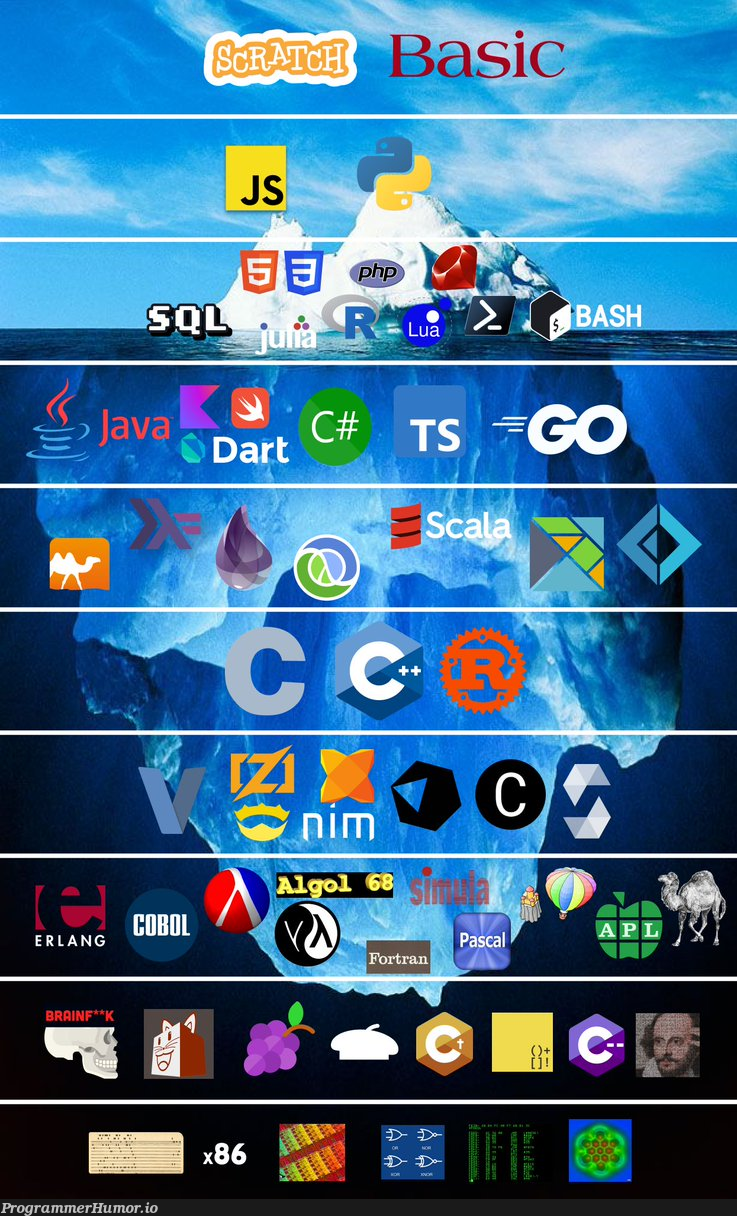
That middle band is where Java, C#, and Ruby earned their keep: managed runtimes, classes, garbage collection, frameworks that pay mortgages. Productive. Serious. Not assembly cosplay. Not “hello world in seven lines” scripting either. Medium tier.
Beskid is named after medium mountains because it targets medium-tier language territory—see 1.3 Current state of languages for the full rant with receipts.
| Mountain metaphor | Language tier | Examples | Beskid’s stance |
|---|---|---|---|
| Alps / high peaks | Systems & machine layer | C, Rust, Zig, assembly | Respect them; do not pretend every form renderer needs them |
| Beskids — middle ridges | Managed daily drivers | Java, C#, Ruby, Go-adjacent ergonomics | Ship business software without VM identity crisis |
| Flat lowlands / tip of iceberg | Scripting & glue | Python, JS, PHP | Fine for glue; not the whole stack |
The Beskids are not the highest Carpathian summits. They are the workhorse ranges—long, layered, lived-in. That is the design target: C#-grade productivity without the platform tax, Java-grade structure without twenty years of ceremony fossilized in corelib, Ruby-grade expressiveness without runtime surprise—compiled, explicit, and meant for codebases that outlive one sprint.
Still literal, still regional
Section titled “Still literal, still regional”Secondary reasons still apply:
- Home ground, not a myth brand. No fake Latin gravitas. No “SynergyLang 3000.” Search “Beskid” and you get maps and trail photos before venture-capital decks.
- Layered ranges, not one hero peak. Software is stacks of compromises; the Beskids are many ridges, not a single summit for LinkedIn posts.
- Daily terrain. Most code is CRUD on a hillside, not a keynote ascent of K2.
This chapter is still about why the language exists, not about hiking. If you wanted trail conditions, you opened the wrong book—unless your ERP also needs elevation profiles, in which case we should talk.
Next: 1.2 My story.